A parcel goes out. Three days later it comes back, or sits in a depot, or gets marked "address not found." Nobody logged a cost against it. The shipping bill absorbed the outbound leg, the warehouse absorbed the return to sender, support absorbed the thread, and the reship went out as if it were a new order.
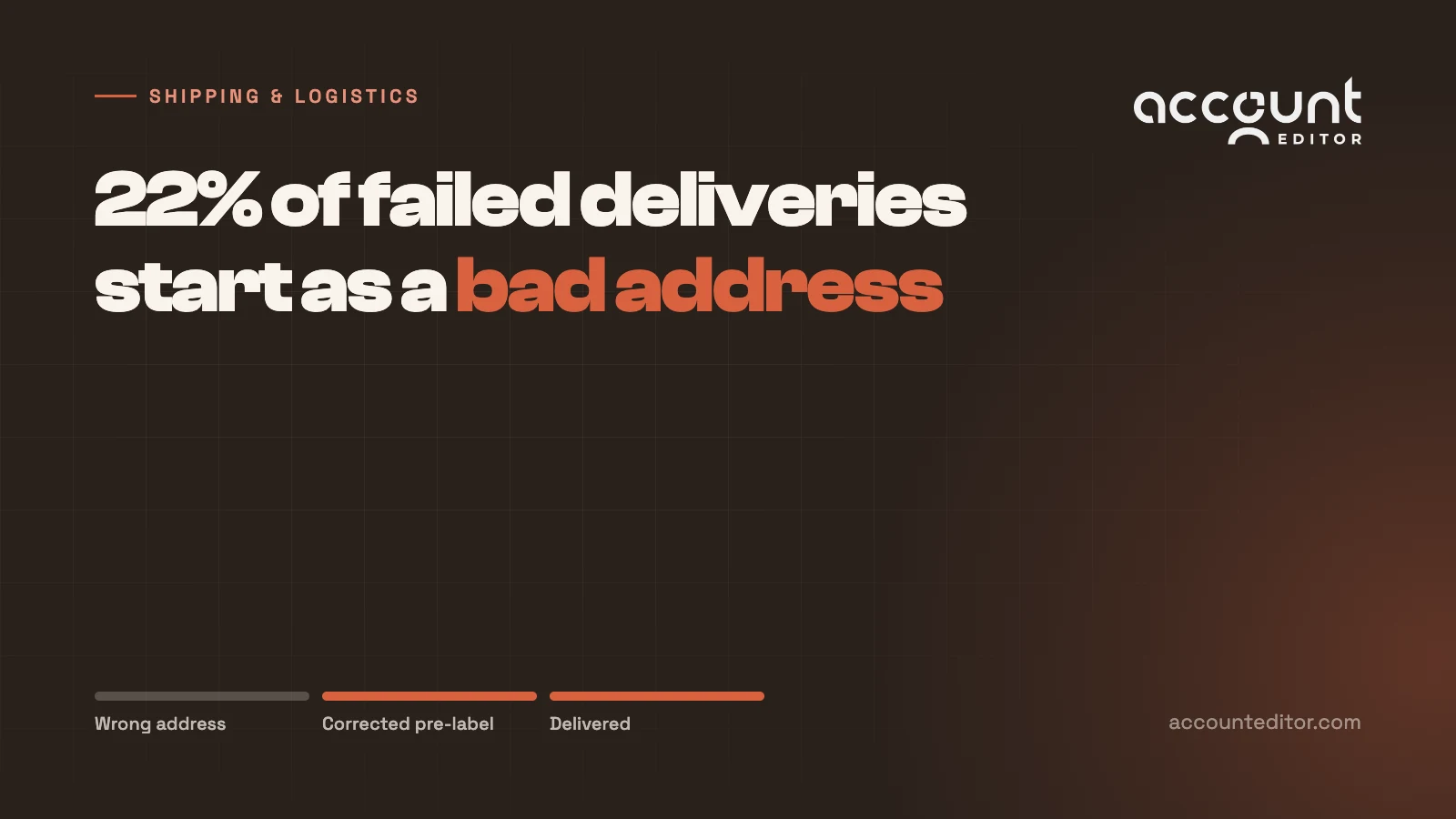
Failed deliveries are the least-tracked expense in ecommerce operations, and the numbers are not small. Industry analysis puts the direct cost of an unsuccessful delivery attempt at around $17.78 per parcel, rising to $15–40 once reship, support time, and churn are included. And roughly 22% of delivery failures trace back to incorrect or incomplete address information given at checkout — the single largest controllable cause.
That last figure is the important one, because an address typed wrong at checkout is fixable for free right up until the label prints. After that it becomes the most expensive kind of shipping error.
This guide covers:
What a failed delivery actually costs once every step is counted
Why address errors happen and when the customer notices
Why validation at checkout is necessary but not sufficient
The post-checkout correction window, and how to open it
What changes at peak season and for cross-border
What a Failed Delivery Costs
First-attempt delivery success runs around 97.2% in the US and 93.7% in the UK, with failure rates ranging from roughly 8% to 20% depending on geography, carrier network, and delivery type. On a thousand orders a month, even the optimistic end of that range is dozens of failures.
The Costs You Can See
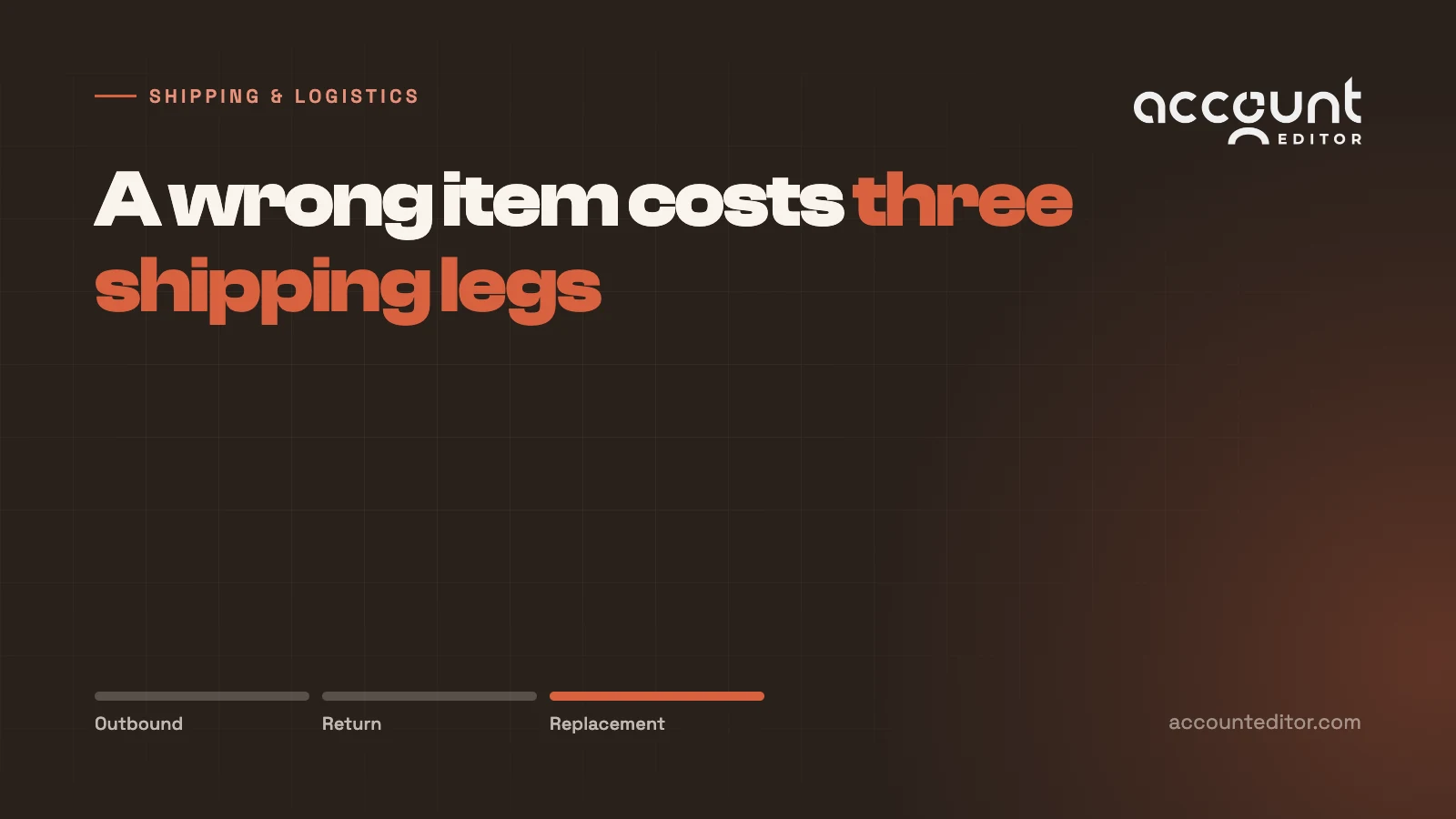
The outbound shipping you already paid, the return-to-sender leg, and the replacement shipment. Three carrier charges for one delivered order.
The Costs You Cannot
Warehouse labour to receive and re-pick, support time to diagnose and reassure, payment processing on any refund, and the inventory that sat in transit instead of on a shelf. These land in payroll, shipping bills, and stock adjustments — never in a line item labelled "failed delivery," which is exactly why the total is routinely underestimated.
The Cost That Dwarfs the Others
Around 70% of shoppers are unlikely to buy again after a delivery failure. On any reasonable view of lifetime value, that single number exceeds every operational cost above combined. A failed delivery is not a logistics incident; it is a churn event with a logistics invoice attached.
Why Addresses Are Wrong, and When Customers Notice
Address errors are not carelessness. They are a predictable output of how checkout works.
Autofill Is Confidently Stale
Browser and platform autofill will cheerfully complete a form with an address the customer moved out of two years ago. It is fast, it looks right, and it is wrong. This is the most common failure and the hardest for the customer to catch, because nothing about the checkout felt like a mistake.
Mobile Checkout Rewards Speed Over Accuracy
Small fields, thumb typing, and unclear labels produce missing unit numbers, transposed postcodes, and street names truncated by an aggressive autocomplete. Peak-season and promotional traffic skews heavily mobile, which is why the error rate is worst exactly when volume is highest.
Gifting Breaks the Assumption Entirely
During gifting periods a meaningful share of orders ship somewhere the buyer does not live, from an address book that may be years out of date. Neither the buyer nor your validation logic necessarily knows the recipient moved.
The Timing Pattern That Matters
In almost every case the customer discovers the error shortly after the confirmation email arrives — the moment they see the address rendered back to them outside a form field. That is minutes to hours after checkout, and it is almost always before the parcel ships. The information needed to prevent the failure exists, in the customer's head, while the order is still editable. Most stores have no mechanism to collect it.
Checkout Validation Is Necessary and Not Sufficient
Address validation at checkout is the right first move. It catches malformed postcodes, non-existent streets, and missing required fields, and every store should have it on.
But validation answers "is this a real, deliverable address?" It cannot answer "is this the address where the customer currently lives?" A perfectly formatted, fully deliverable previous address passes every validation check ever written and still fails delivery. So does a valid building address missing the apartment number.
That is the residual category, and it is where most of the 22% lives. Closing it requires a second checkpoint after the customer has seen their order — not a stricter version of the first one.
Opening the Post-Checkout Correction Window
The mechanic is straightforward: let customers correct their own address after checkout, before the label prints, without contacting anyone.
Put the Address on the Confirmation Path
Show the shipping address prominently in the confirmation email and on the order status page, with an obvious way to change it. Most address errors are caught at this exact moment, so this is where the correction has to live. A customer who has to open a support ticket will frequently just hope for the best instead — and hope is what produces the failed delivery.
Validate the Correction Too
A self-serve address change with no validation trades one bad address for another. Validated suggestions on the edit mean the corrected address is deliverable, not merely different.
Recalculate What the New Address Changes
A different destination can mean different shipping rates, different tax, and different duties. Corrections that skip recalculation quietly move the cost onto your margin, which matters most on cross-border orders.
Hold Fulfillment Until the Window Closes
This is the step that makes the rest real, and the one most often skipped. If your 3PL pulls orders the moment they are paid, a customer correcting their address at minute three is editing an order whose label already printed. The fulfillment hold has to match the correction window, or the window is decorative.
Where the Stakes Are Highest
Cross-Border
A failed international delivery adds customs handling, return freight that frequently exceeds the item's value, and duty reconciliation. Some parcels are genuinely not worth recovering, which converts the failure into a full write-off rather than a reship. Address accuracy carries disproportionate value here.
Peak Season
Volume multiplies, checkouts skew mobile, gifting addresses proliferate, and carriers run at capacity with less tolerance for redelivery. It is the worst possible combination, and it lands in the same weeks as your highest order count. Worth reading alongside BFCM fulfillment readiness.
High-Value and Signature-Required
Where redelivery requires someone present, an incomplete address does not just delay the parcel — it can strand it through multiple attempts before returning to sender, accruing cost at every step.
What to Measure
Prevention is invisible by nature, so track the inputs rather than waiting for the absence of failures to show up somewhere.
First-attempt delivery rate — the headline number, segmented domestic against cross-border
Post-checkout address correction rate — corrections made before the label printed; every one is a failure that did not happen
Failure reason codes from your carriers — address-related versus recipient-unavailable, because only the first is yours to fix
Reship rate and cost — the direct expense, tracked as its own line rather than absorbed into shipping
Corrections after the window closed — the strongest signal that your window is too short
The pairing that tells the real story is correction rate against address-related failure rate. If corrections climb while address failures fall, the window is doing its job. Operations analytics that reconcile against your Shopify data make that measurable rather than anecdotal.
Conclusion: The Cheapest Fix Has the Shortest Deadline
Correcting an address costs nothing while the order is a database record. It costs around $17.78 in direct expense, plus labour, plus a roughly 70% chance of losing the customer, once a parcel is moving toward the wrong place.
Between those two states sits a window of minutes or hours, which is exactly when the customer notices. The entire discipline of preventing failed deliveries comes down to being reachable during that window, validating what comes back, and making sure the warehouse waits long enough to hear it.
Validation at checkout catches malformed addresses. Only a post-checkout correction path catches wrong ones.
Close the Address Gap
If address-related failures are showing up in your carrier reports, the fix sits in the window between the confirmation email and the printed label.
Account Editor lets customers correct their own shipping address after checkout with validated suggestions, recalculates shipping and tax for the new destination, and holds fulfillment so the corrected address reaches your warehouse before the label prints.
See how Account Editor prevents failed deliveries at the source.