
Post-purchase glossary.
A working vocabulary for the post-purchase moment on Shopify. These are the terms we use across the product, the docs, and the dashboards — written for operators and engineers who want a precise definition, not a marketing one.
- 15Terms defined
- 1,200+Stores using these
- 5 minAverage read
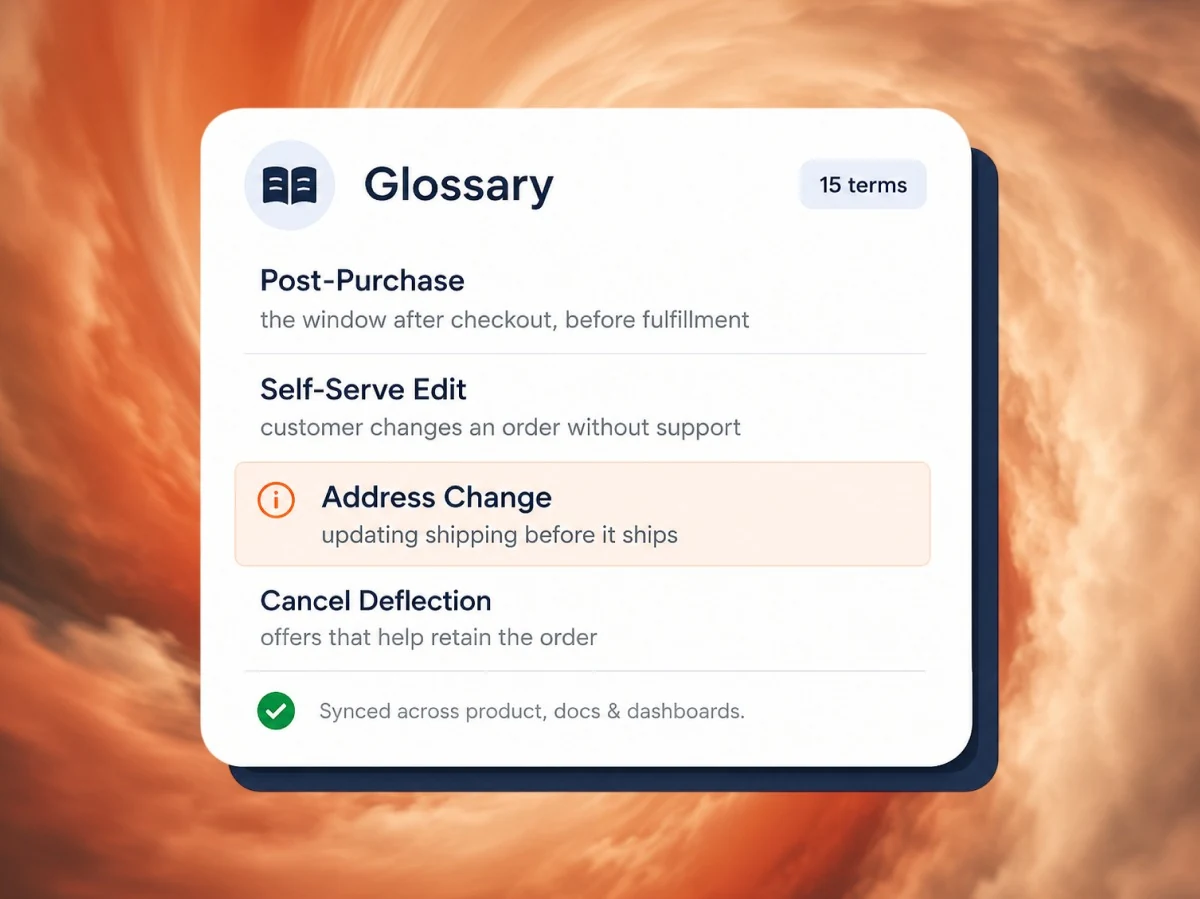
- 01Post-purchase window
- The period between order placement and warehouse pick — typically a few minutes to several days depending on fulfillment SLA — during which an order can still be modified, cancelled, or added to without touching the shipped package. The post-purchase window is the operating surface for self-serve edits, cancel deflection, and one-click upsells.
- 02Cancel deflection
- The practice of intercepting a customer who has clicked "cancel" and offering an alternative that keeps the revenue — usually store credit at a small bonus, a free shipping upgrade, a variant swap, or a partial refund — before the cancel is executed. A well-tuned deflection flow typically saves 30–40% of would-be cancels and captures the reason code on the rest.
- 03Edit window
- The merchant-defined time period after checkout during which a customer can self-edit their own order. The window is usually configurable per product, collection, tag, or fulfillment status so same-day SKUs can lock quickly while pre-orders stay editable for weeks. The right edit window matches your fulfillment SLA, not a default.
- 04Order combining
- Merging two or more separate orders from the same customer — placed within a short window and shipping to the same address — into a single shipment. Done correctly, combining lowers shipping cost, reduces carbon, and produces one tracking number for the customer; done badly it desyncs the orders from Shopify and confuses the 3PL.
- 05Address validation (in post-purchase context)
- The check that confirms a shipping address is real, deliverable, and free of typos before the order is released to fulfillment. In post-purchase, validation usually happens at the moment of edit — the customer is presented with a suggested correction (apartment number, ZIP+4, country format) and can accept it in one tap, blocking obvious failures before they reach the 3PL.
- 06AOV (Average Order Value) lift
- The incremental increase in average order value attributable to a specific intervention — usually a post-purchase upsell, bundle offer, or cross-sell. AOV lift is calculated against a control cohort, reported as a percentage, and is the cleanest way to value post-purchase tooling against ad-spend-funded acquisition.
- 07Self-serve order editing
- A customer-facing flow that lets the buyer modify their own order — address, variant, quantity, add-on item, contact details — without contacting support. Self-serve editing converts what was previously a CX ticket into a buyer-completed action, typically deflecting 80%+ of edit-related support volume.
- 08Shopify order edit API
- Shopify's official GraphQL API surface for programmatically modifying an existing order — adding line items, changing quantities, applying discounts, updating addresses, and capturing or refunding the resulting payment difference. Apps that write edits through this API produce real Shopify Order events, which means downstream apps (ESPs, helpdesks, 3PLs, BI tools) see the corrected order natively.
- 09Fulfillment hold
- A temporary block placed on an order that prevents it from being picked or shipped while an edit, validation, or review is in progress. Holds can be triggered automatically (failed address validation, customer-initiated edit in progress) or manually (CX agent investigation) and are released the moment the underlying condition is resolved.
- 10Post-purchase upsell
- An offer presented to the customer after checkout has completed but before the warehouse has picked the order — typically on the Thank You page, in the confirmation email, or inside an Order Status widget. Because the payment method is already on file and the package has not shipped, accepted upsells charge in one tap and add to the same box, with no extra shipping cost.
- 113PL (Third-Party Logistics)
- An outsourced fulfillment provider that warehouses inventory, picks and packs orders, and ships them on behalf of a merchant. Common examples include ShipBob, ShipHero, and most carrier-managed warehouses. In a post-purchase context, edits have to round-trip through the 3PL so a change inside Shopify reflects on the picked package — bi-directional sync is the difference between a real edit and a paperwork edit.
- 12Bi-directional sync
- A data connection between two systems — usually Shopify and a fulfillment platform or 3PL — where state changes flow in both directions. A bi-directional sync means an edit applied in Shopify updates the 3PL queue, and a status change at the 3PL (picked, packed, shipped) flows back to Shopify and locks the edit window. Without it, edits can be silently overwritten by a stale fulfillment state.
- 13Iframe-based widget
- A storefront widget rendered inside a sandboxed iframe element, isolating the widget's JavaScript, CSS, and DOM from the surrounding theme. Iframe-based widgets install via App Block or a single script tag, avoid theme-CSS collisions, and update independently of the merchant's storefront — the standard delivery model for embedded post-purchase tools on Shopify.
- 14Deflection rate
- The percentage of customer-initiated cancel or change attempts that result in the order being kept rather than refunded. A deflection rate of 35% means that for every 100 customers who clicked "cancel," 35 accepted an alternative — store credit, upgrade, swap — and the order completed. Deflection rate is the cleanest KPI for measuring the revenue impact of a post-purchase platform.
- 15Recovered revenue
- The dollar value of orders that would have been cancelled or refunded but were retained through a deflection or self-edit action. Recovered revenue is reported net of any incentive cost (store-credit bonus, free upgrade) and, in a well-built platform, is reconciled to the Shopify ledger so finance can sign off on the number without rebuilding it from CSV exports.
Put it into practice
The vocabulary, in your own dashboard.
Install free on Shopify and watch edit window, deflection rate, and recovered revenue populate against your own orders.