
Most Shopify returns end in a cash refund because that's what the returns page offers first. Changing which option comes first is one of the few returns levers you fully control.
The Number Worth Managing
When a returns flow puts a cash refund ahead of exchange or store credit, it can influence which resolution customers choose.
The number that moves faster is the resolution mix: what share of returns end in a cash refund versus an exchange or store credit. The item comes back either way. Whether the revenue goes with it is largely down to how your returns page is configured.
Here's the shape of it. Take a store with $500,000 of returned merchandise in a year. At an 80/20 split of refunds to exchanges, you keep $100,000. At 50/50, you keep $250,000. Same return rate, same logistics cost, and an illustrative $150,000 difference in retained revenue from nothing more than which option the customer saw first.
Your own numbers will differ. The point is that the gap exists and it's reachable.
Around 19.3% of online sales were returned in 2025 according to the NRF and Happy Returns 2025 Retail Returns Landscape, so for most stores this is not a rounding error.
Account Editor handles the returns flow on 1,200+ Shopify stores. If you want to see the exchange-first setup rather than read about it, the 14-day trial has no card required.
Why Most Returns Become Refunds
Three practical reasons can push customers toward refunds.
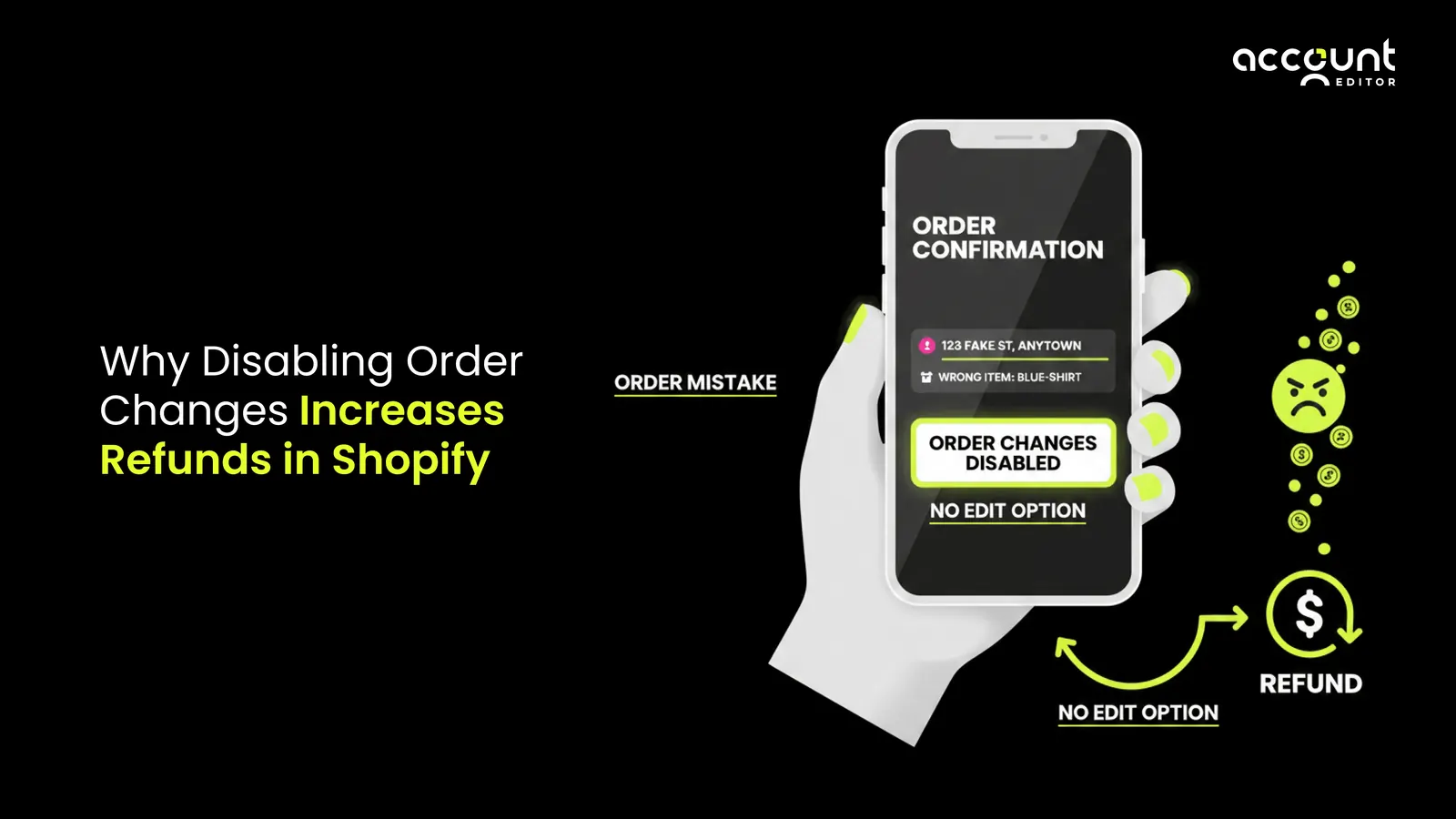
The refund is the first option. If "Refund to original payment method" sits at the top and exchanges are behind a dropdown or an email to support, you have a refund-first flow whatever your policy page says. It is the same mechanism that makes disabling order changes increase refunds: the path of least resistance wins.
Refunds are certain. A customer knows exactly what a refund gets them. An exchange that requires a conversation, a wait, and a hope that the replacement is in stock is a worse deal from where they're standing, even when it isn't.
Nothing makes staying more attractive. A refund and a store credit of the same value are not a real choice. A store credit worth more than the refund is.
Worth noting what's underneath this: a large share of returns, commonly estimated at around 45% across categories, come down to fit and sizing. In those cases the customer wanted the product. They wanted a different size of it. A refund there is a sale you had and gave back, and it's the clearest case for putting an exchange in front of them. Catching the same mistake earlier — before the parcel ships — is cheaper still.
Building an Exchange-First Flow in Account Editor
Returns & Exchanges sits alongside the order editing merchants already run in Account Editor, where 500,000+ orders have been self-edited and 137,000+ bad addresses caught. Same idea applied after delivery: the customer resolves it themselves, and the default resolution is the one that keeps the revenue in the business.
Resolutions Change Based on the Reason They Give
This is the setting that does most of the work.
A store-wide resolution list shows every option to every customer, including a refund to someone who just wanted a medium. Setting resolutions per return reason means "Too small" offers a size swap, "Damaged" offers a replacement, and "Changed my mind" offers store credit.
You define what an exchange can be: same product, same price, same category or product type, or any product within collections you choose, with price rules attached. When the replacement costs more the customer pays the difference. When it costs less, the balance goes back as a refund, store credit, or nothing, depending on how you set it.
Store Credit That's Worth More Than the Refund
Store credit is the option for customers who want to come back but don't know what they want yet.
Add a bonus percentage and the decision changes for the customers who were on the fence. Tier the bonus by speed, with more for returns started within seven days, and stock comes back while it can still sell.
You can also set full-price-only refunds, so anything bought on sale resolves as credit rather than cash.
The Replacement Is Held the Moment It's Picked
Inventory hold reserves the exchange item as soon as the customer selects it. Without it, an exchange can fail because the replacement sold out in the days between the request and the shipment, and a failed exchange usually becomes a refund plus a support ticket.
See it running on your own store. Account Editor is rated 5.0 across 259 reviews on the Shopify App Store, with human support on every plan. Start a 14-day free trial.
An Offer Before the Return Starts
The cheapest return is the one that doesn't happen. Before the request completes you can offer store credit, a gift card, a discount, or free shipping to keep the item, targeted by order total, quantity, product, collection or customer segment.
This earns its place on low-value items where processing the return costs close to what the item is worth. It is the same deflection logic that keeps cancellations from becoming lost revenue, applied after delivery instead of before fulfillment.
What You See Afterwards
Requests land in one dashboard with the items, photos, timeline and charges. Automation rules can approve the clean cases, flag the rest, and waive fees where you've marked a reason as damaged. Analytics reports revenue kept via exchange or credit against revenue refunded, which is the resolution mix in one line.
Everything stays in sync with Shopify's native returns, so orders, refunds and inventory match.
4 Shopify Returns Settings That Can Increase Exchanges
Turning the feature on doesn't change anything by itself. These four do most of it.
Set resolutions per return reason, not store-wide. Highest-impact setting in the product. Configure this before anything else.
Make the store credit bonus large enough to notice. A 2% bonus changes nobody's mind. Start around 10–15% and read the resolution mix after 30 days.
Turn on inventory hold. Unglamorous, and it protects exchanges that would otherwise revert to refunds.
Run new automation rules as flag-for-review first. Two weeks of watching what a rule would have approved is cheaper than one wrong auto-approval on a high-value order.
Conclusion
Tightening your returns policy tends to cost you sales at the top of the funnel, and the NRF and Happy Returns research found 82% of consumers weigh free returns when deciding whether to buy at all.
The alternative is leaving the policy alone and changing what the customer is offered when they're already returning. Lead with the right exchange for the reason they gave, make credit worth more than cash, and hold the replacement so the exchange doesn't fall through.
Same returns. Different mix.
Build an exchange-first returns flow this week. 14-day free trial, live in minutes, no developer needed. Install Account Editor on Shopify.